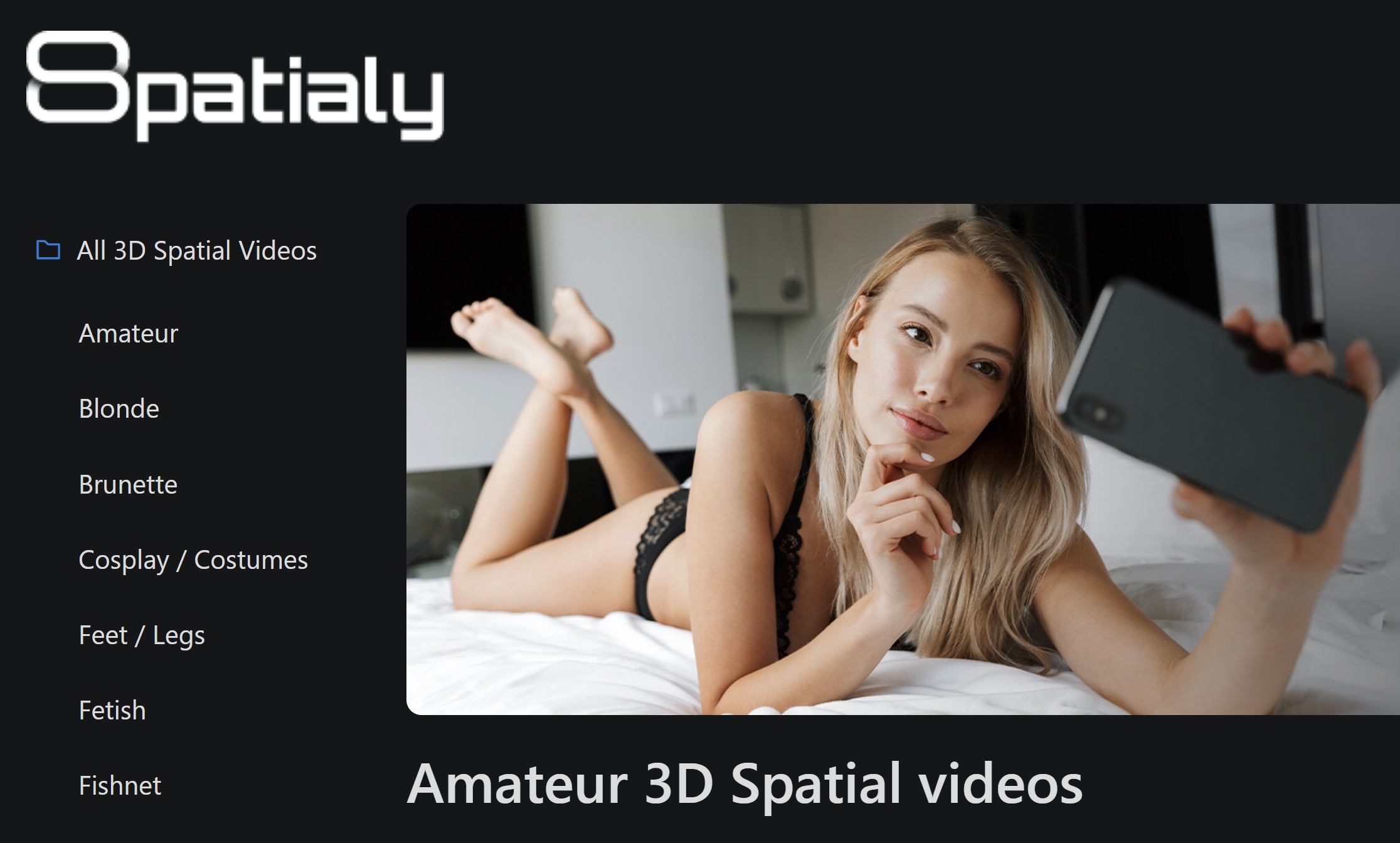
The VR adult entertainment landscape may be on the verge of a significant shift. Spatialy (spatialy.fans), a new platform specializing in “spatial video” distribution, has officially launched with an ambitious goal: lowering the barriers that have historically made immersive adult content difficult and expensive to produce.
The Production Problem
Anyone who’s followed the VR adult industry knows that high-quality immersive content has remained frustratingly scarce compared to traditional video. The reasons are well-documented: specialized 180° or 360° camera rigs, complex stereoscopic workflows, technical expertise requirements, and substantial production costs have kept the barrier to entry high. While major studios have managed to establish VR divisions, independent creators and smaller operations have largely been priced out of the immersive market.
Enter Spatial Video
Spatialy’s approach leverages the spatial video capabilities now available on consumer devices—most notably recent iPhone models—to change that equation. The platform operates on three main tracks:
- Native Uploads: Creators can upload spatial videos captured directly on compatible iPhones, eliminating the need for specialized camera equipment
- AI Conversion: Existing 2D video libraries can be processed into stereoscopic 3D using AI tools, potentially unlocking back catalogs for VR audiences
- Distribution Infrastructure: Built-in monetization tools designed specifically for immersive content
Why This Matters for Viewers
From the viewer perspective, the promise is straightforward: more content, from more creators, with genuine depth and presence. While the press materials stay appropriately professional, VR enthusiasts know exactly what “presence” and “connection” translate to in this context—the sense of actually being there rather than watching from outside.
Traditional flat video, even in high resolution, fundamentally operates at a distance. Spatial and stereoscopic content, by contrast, creates that elusive sense of shared space that makes VR compelling in the first place. If Spatialy’s technology delivers on its promise, the result should be content that feels more immediate and personally engaging.
Questions Remaining
As with any new platform, execution will determine success. The quality of AI-driven 2D-to-3D conversion remains a critical question—early implementations of this technology have ranged from impressively convincing to headache-inducing. Similarly, spatial video captured on smartphones, while accessible, faces limitations in resolution and field of view compared to dedicated VR camera rigs.
Still, for a market that’s been hungry for more content variety, Spatialy’s launch represents an interesting development. The combination of accessible capture technology and AI-assisted production tools could potentially expand the creator pool significantly.
The platform is now live at spatialy.fans for creators interested in exploring the tools and viewers looking for new immersive content.